
AI Testing Use Cases
Real-world methodologies demonstrating how WeAreQA approaches test automation for AI-powered products
Two real-world use cases demonstrating how WeAreQA approaches test automation for AI-powered products — covering both AI product testing and AI-powered QA workflows.
Testing AI Products
How we validate the quality, reliability, and safety of AI-powered applications
End-to-End Testing of AI Chatbots at Scale
Overview
Modern AI chatbots are no longer simple Q&A systems — they are complex, stateful conversational agents capable of handling multi-turn dialogues, reasoning tasks, and dynamic user interactions. Traditional testing approaches fail in this context because chatbot outputs are non-deterministic, context-dependent, and highly sensitive to prompt variations.
To address this, we implemented a comprehensive AI chatbot testing framework that validates conversational quality, robustness, and reliability across real-world scenarios.
The Challenge
AI chatbot systems introduce several critical testing challenges:
- •Non-deterministic outputs — the same input may produce different responses
- •Context dependency — each response depends on the full conversation history
- •Multi-turn complexity — errors may only appear after several dialogue steps
- •Model variability — different AI models behave inconsistently across the same scenario
- •Hidden failures — hallucinations, bias, or logical inconsistencies are hard to detect manually
Standard QA approaches with fixed expected outputs are insufficient for validating such systems.
Our Approach
We built a scalable, automated evaluation pipeline designed specifically for AI chatbots.
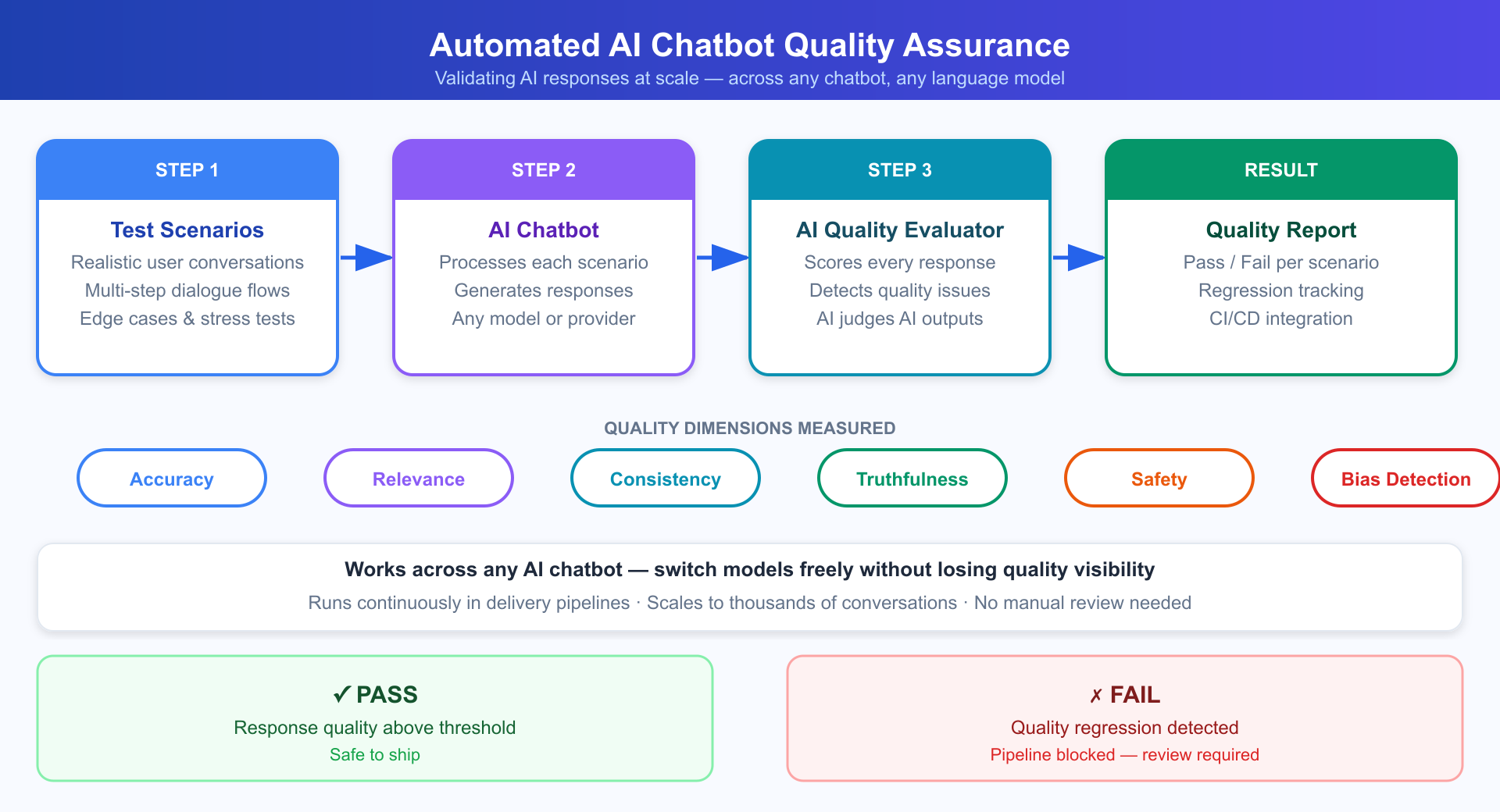
AI Chatbot Testing Pipeline
1. Multi-Turn Conversation Testing
We test full conversational flows, not just isolated prompts.
- Simulate real user interactions across multiple steps
- Validate context retention and logical consistency
- Group conversations into scenarios to ensure reproducibility
2. Model-Agnostic Testing
We validate chatbot behavior across multiple AI models:
- Compare responses from different AI providers
- Detect regressions when switching models or prompts
- Ensure consistent quality regardless of the AI backend
3. Automated Evaluation with AI-as-a-Judge
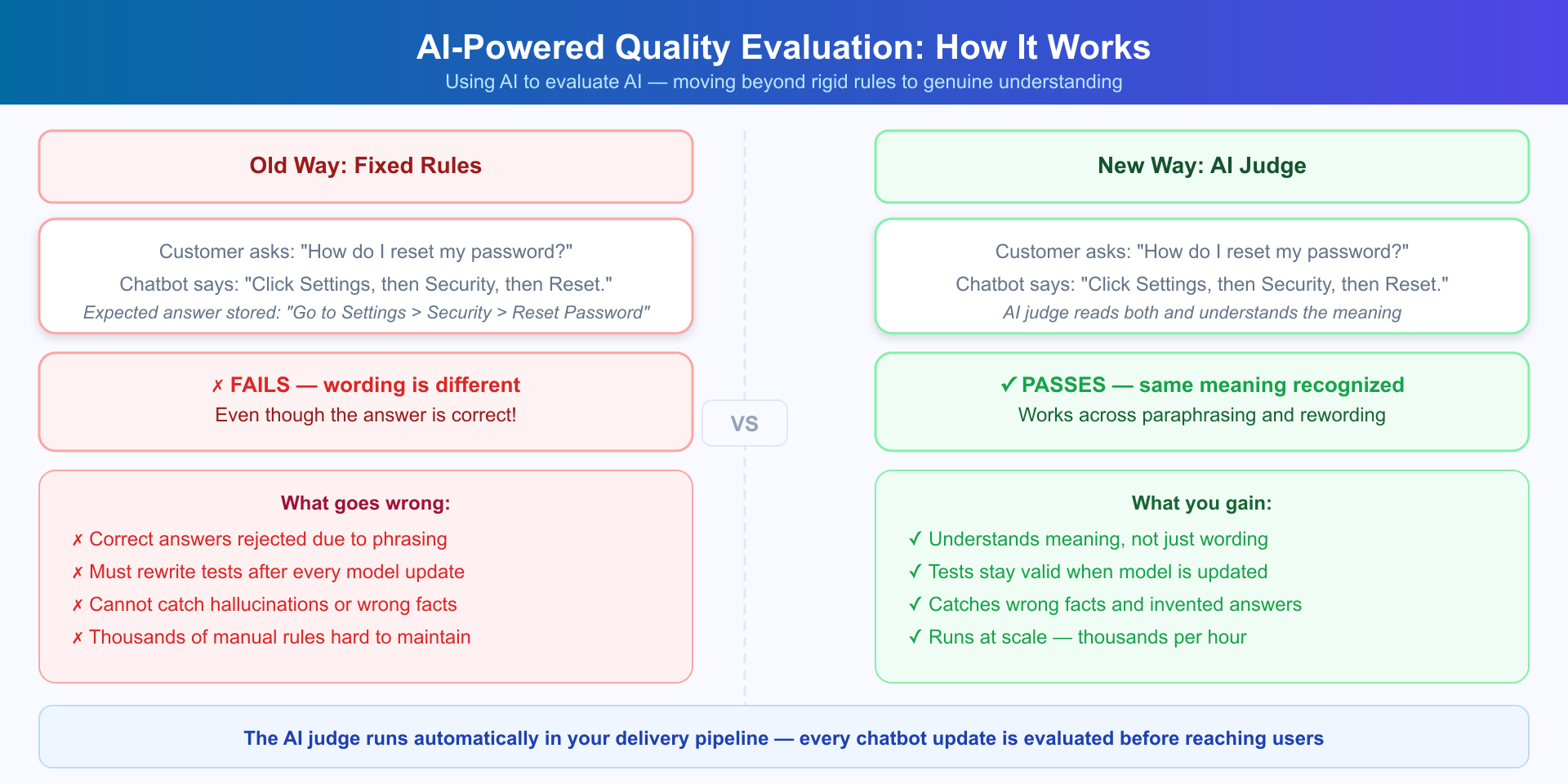
LLM-as-a-Judge: Non-Deterministic Output Evaluation
Instead of hardcoded assertions, we use AI-based evaluation:
4. Metrics-Driven Validation
50+ research-backed metrics covering answer relevancy, faithfulness, hallucination detection, coherence, task completion, and toxicity.
5. Automated Framework
CI/CD integration with structured test cases, synthetic conversation generation, and multi-turn evaluation support.
6. Adversarial Testing
Prompt injection scenarios, ambiguous inputs, long conversations, and invalid queries to identify vulnerabilities.
7. Continuous Testing
Tests run on every model/prompt change with instant regression detection and automated reporting.
Results
- ✓Significant reduction in undetected chatbot errors
- ✓Faster iteration cycles for prompt and model updates
- ✓Improved response consistency across scenarios
- ✓Early detection of hallucinations and logical failures
Where This Applies
- →Customer support chatbots
- →AI assistants and copilots
- →RAG (Retrieval-Augmented Generation) systems
- →Enterprise AI tools
Testing On-Device AI in a Privacy-First Mobile Application
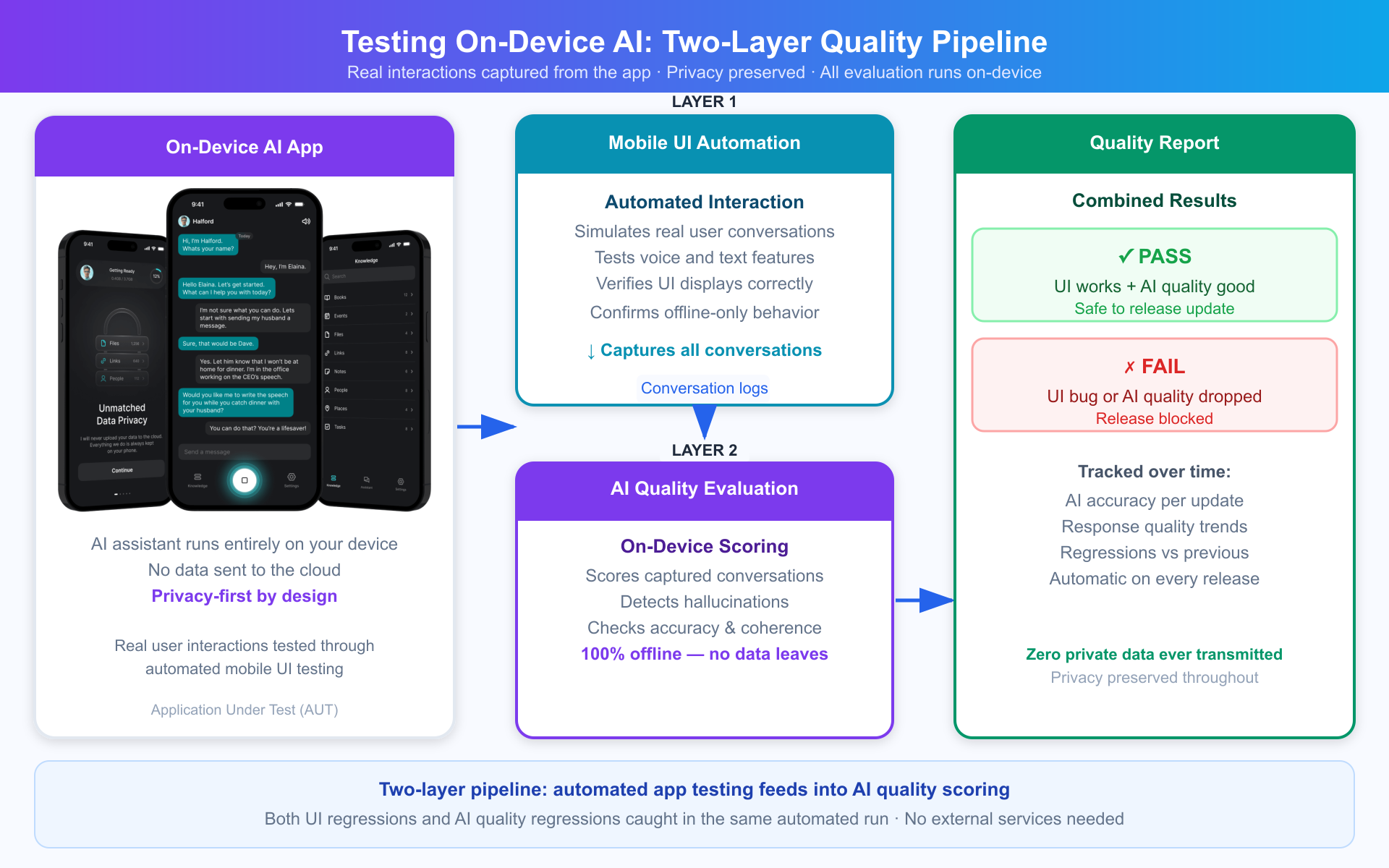
On-Device AI Testing Pipeline
Our client built a privacy-focused AI mobile app that runs AI models entirely on the user's device — no cloud, no data uploads. All AI processing happens locally, using models optimized for mobile hardware.
This architecture introduces a unique testing challenge: how do you validate AI output quality when there is no server to intercept, no external API to call, and no data allowed to leave the device?
We solved this by building a two-layer automated pipeline where mobile UI automation captures authentic model responses, and an AI quality evaluator then scores those responses — all running locally, with zero data leaving the device.
The Challenge
- •No server-side visibility — AI responses live inside the app
- •Hardware variability — model behavior differs across devices
- •Compressed models — optimized models behave differently
- •Privacy constraints — test data cannot leave the device
Our Approach
We designed a two-layer pipeline where mobile automation captures real app responses and an AI evaluator scores their quality.
Layer 1 — Mobile UI Automation
- Simulate realistic multi-turn conversation scenarios
- Interact with voice and text input features
- Confirm fully offline operation — no network calls
- Capture actual AI responses for quality evaluation
Layer 2 — AI Quality Evaluation
- Conversation logs become scored test cases
- Local AI judge evaluates quality — no external services
- Quality dimensions: accuracy, coherence, relevance, safety
- Structured pass/fail reports per quality threshold
Results
- ✓Authentic quality evaluation grounded in real app responses
- ✓UI and AI regressions detected in single pipeline
- ✓Fully offline — zero data leaves device
- ✓Reduced manual QA effort per model update
Where This Applies
- →On-device AI assistants
- →Privacy-sensitive applications (healthcare, finance, legal)
- →Offline-first mobile AI products
- →Apps using compressed or quantized AI models
Building AI-Powered QA Workflows
Using AI to build QA tooling itself — creating agentic pipelines that automate the work QA engineers do
AI-Powered Test Generation for Enterprise Test Automation
Our client manages a large enterprise platform built from dozens of independent services, maintained by multiple teams in parallel. Every new feature requires automated test coverage — and writing those tests manually is time-consuming, repetitive, and requires deep knowledge of a custom test automation framework with strict conventions.
We built an AI agent that reads a feature ticket and delivers production-ready test code — correctly structured for the project, ready to run, and requiring no manual fixes.
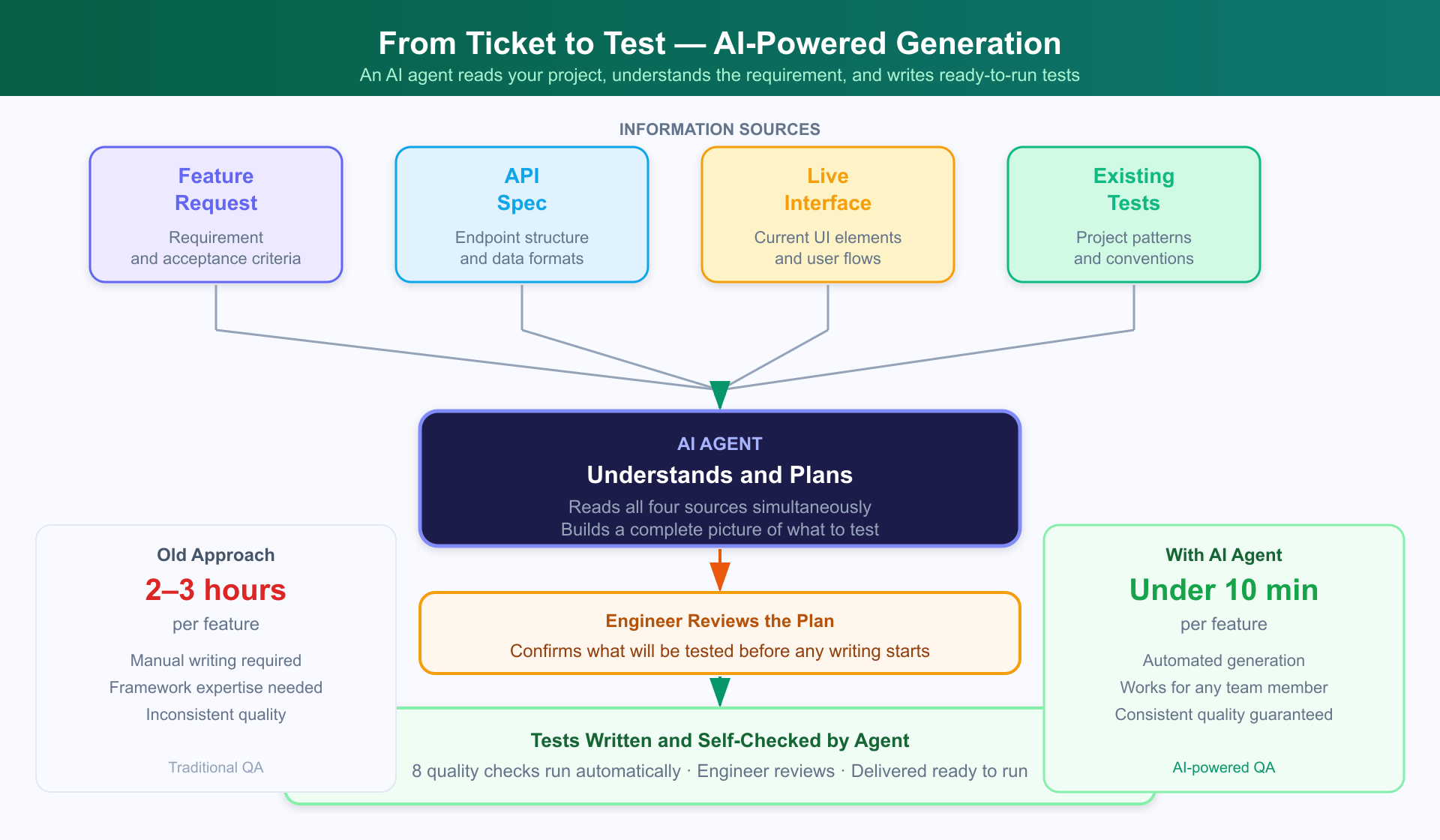
AI-Powered Test Generation Workflow (10-step protocol)
Our Approach
1. Agentic Workflow
The entire workflow is triggered by a single command. The agent follows a structured 10-step protocol with two human approval checkpoints.
2. Project-Aware Code Generation
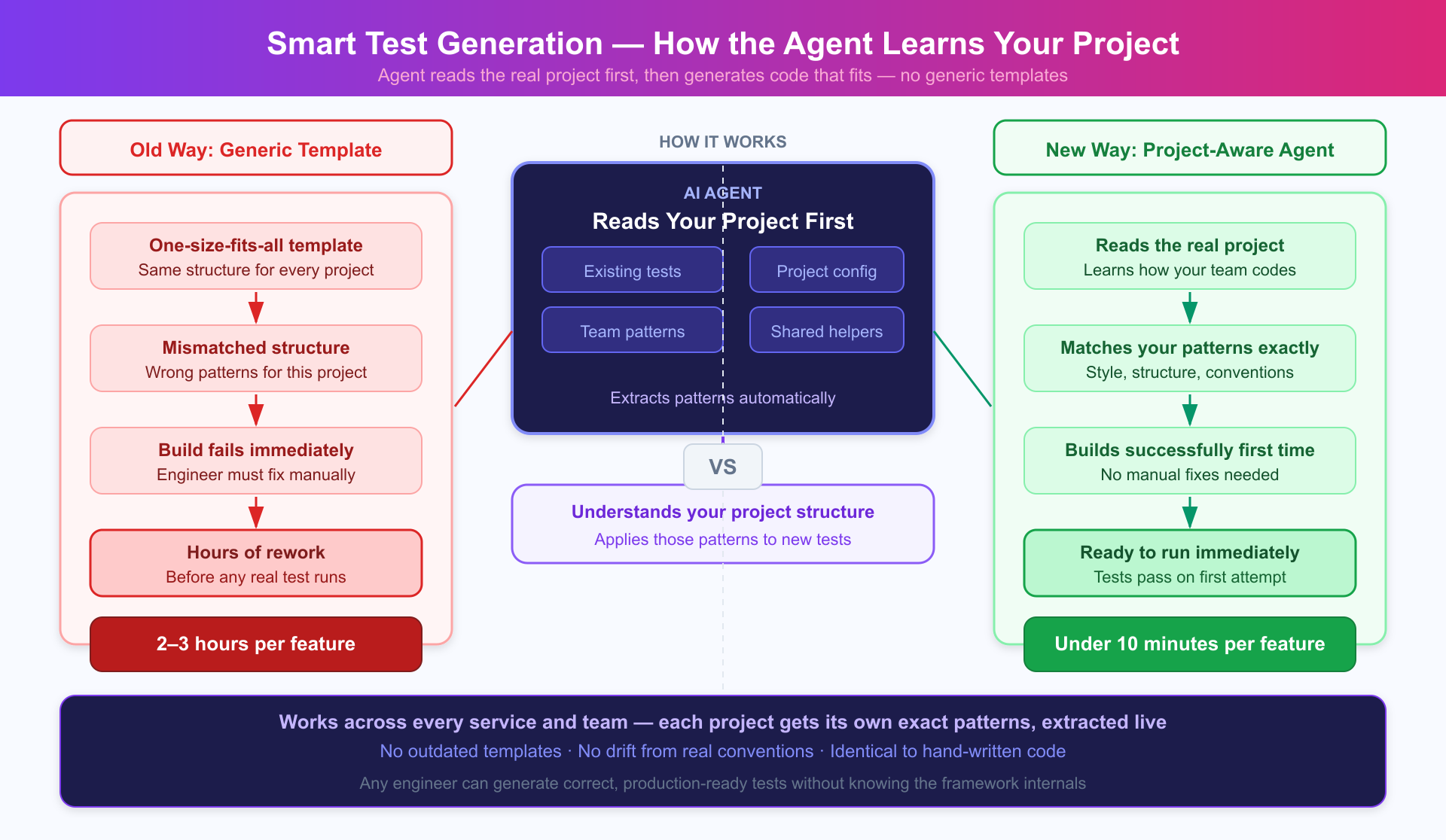
Smart Test Generation — How the Agent Learns Your Project
Rather than relying on hardcoded templates, the agent reads the actual project before generating code:
- Scans existing tests to understand conventions
- Identifies correct structural patterns in use
- Finds shared utilities to reuse instead of duplicating
- Extracts naming and organization conventions
3. Multi-Source Context Fusion
Each test draws from four live sources:
- • Feature ticket (user story)
- • API specification
- • Live UI (interactive elements)
- • Existing tests (patterns)
4. Full Test Coverage
Generates all required test types:
- • End-to-end flow tests
- • Read and query validation
- • Access control tests
- • Error and edge cases
5. Self-Review Quality Gate
Before presenting code, the agent runs an 8-point quality check covering structure, coverage, cleanup, security, metadata, style, and error handling.
6. Session Resilience
The agent saves generation plans. If interrupted, engineers can resume from where it left off with a single instruction.
Results
- ✓Minutes instead of hours — 2-3 hours reduced to under 10 minutes
- ✓Works first time — eliminates structural mismatches
- ✓Full coverage — every criterion mapped to test case
- ✓No framework expertise required
Where This Applies
- →Enterprise test automation frameworks
- →Teams maintaining tests across many services
- →Projects with strict test patterns
- →Organizations reducing manual QA overhead
Ready to discuss AI testing for your product?
Let's explore how WeAreQA's AI testing methodologies can help you ship AI products with confidence.